We spent £15k to exhibit at a live event – Was it worth it?
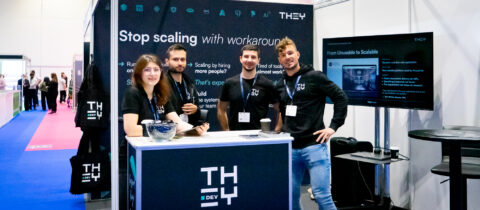
It took us two years to decide whether to exhibit at The Business Show London.
I attended TBS in 2023 as a visitor, with very little knowledge about sales, marketing and networking.
It was an enjoyable experience, but my overall judgement was:
- Everyone is selling there – no one is buying
- It’s hard to make any real business
- You can find everyone there, from Samsung to Avon. It’s too wide.
So it’s better to go for some smaller, niche events where our ICP gathers.
Since then, I’ve started getting notifications about exhibiting at the show.
For then, the price was too high in comparison to what we can do in the digital space for the same amount (at least when it comes to reach). So I was considering going back, but the answer was always no.
Until this year.
One of the exhibitors resigned from attending the show.
As I was in contact with one of the organisers, he offered me the space at the last minute, including the benefits the previous exhibitor had already paid for, at the base price.
So we decided – let’s do it.
Preparation for the event
Formalities
The formal process was easy – at the start.
With TBS, everything happened online. Online calls, e-signatures, invoices, payments, and contact via emails – all straightforward. When I had questions, contact with the account manager was fast and transparent.
So from this perspective, everything was fine.
Things got complicated when we started researching the swag, print house, and furniture provider.
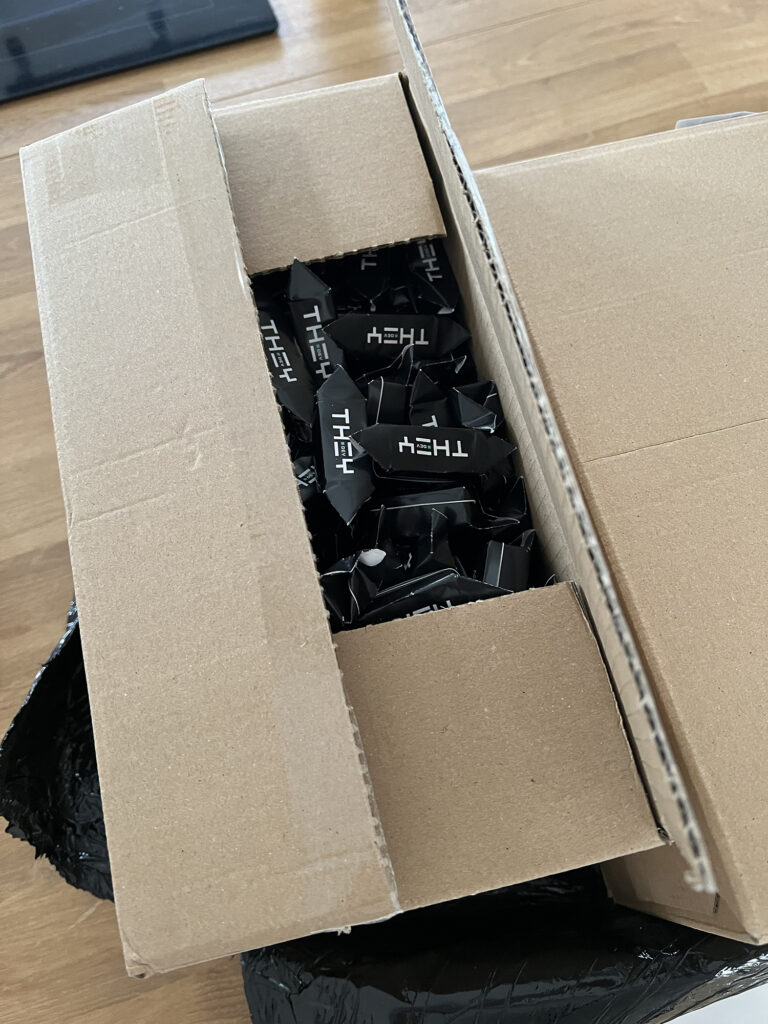
Since we didn’t know what to expect from the first-ever exhibition, we didn’t want to invest a large sum of money in it. This was why we were considering ordering items in Poland and taking them with us to the UK.
Which turned out to be a nightmare for our VA, who was managing it.
Not to get too deep into formalities, it turned out to be easier than we initially thought.
We had to decide whether it would be better to use a courier or just luggage. Also, during the research, it wasn’t clear where and when we pay VAT and customs duties, what documents to fill out, or whether our fudge has enough milk to be considered sweet or dairy. 🐮
In the end, no one checked anything at the border 🙃
Why in Poland, you might ask, which is a great question.
Because everything was 2-3 times cheaper than ordering in the UK.
Digital preparation
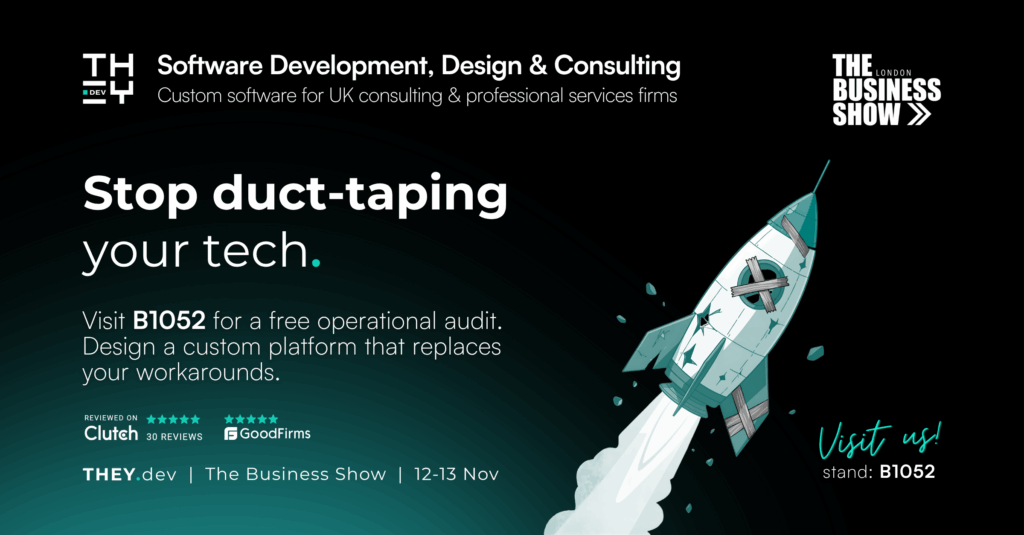
This event was a considerable marketing investment for the company.
So we wanted to get the most out of it.
The preparation in the digital space included:
- Filling our TBS profile
- Figuring out the ICP that we can reach through this event
- Finding them online
- Doing the cold outreach through Li DM’s and email
- Preparing and executing the content plan, which will support all actions
- Plan how to gather attention
- Planning the Ads
- Planning the follow-up strategies
- We included a small rebranding during the preparation, so this was an additional complication
And probably 10 other things that I forgot.
Physical preparation
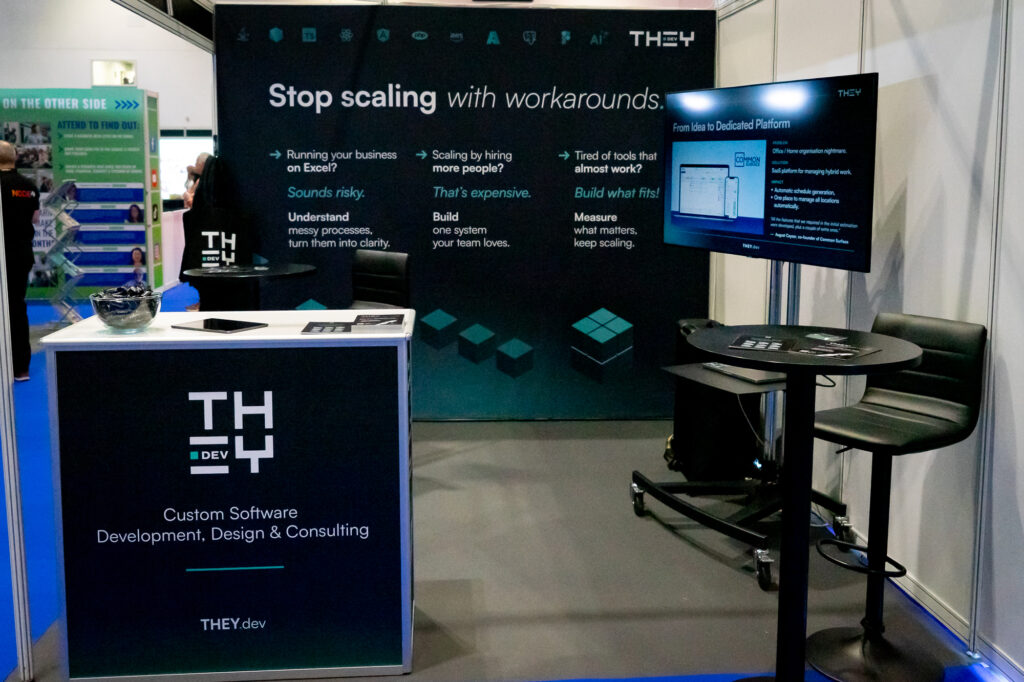
Filling the space was the most expensive of all (except the entry fee).
For the booth/stand costs, the sky is the limit. So I had to plan it well. On the other hand, I didn’t want to sit in an empty booth.
My goal was to present the company in a professional, straightforward manner.
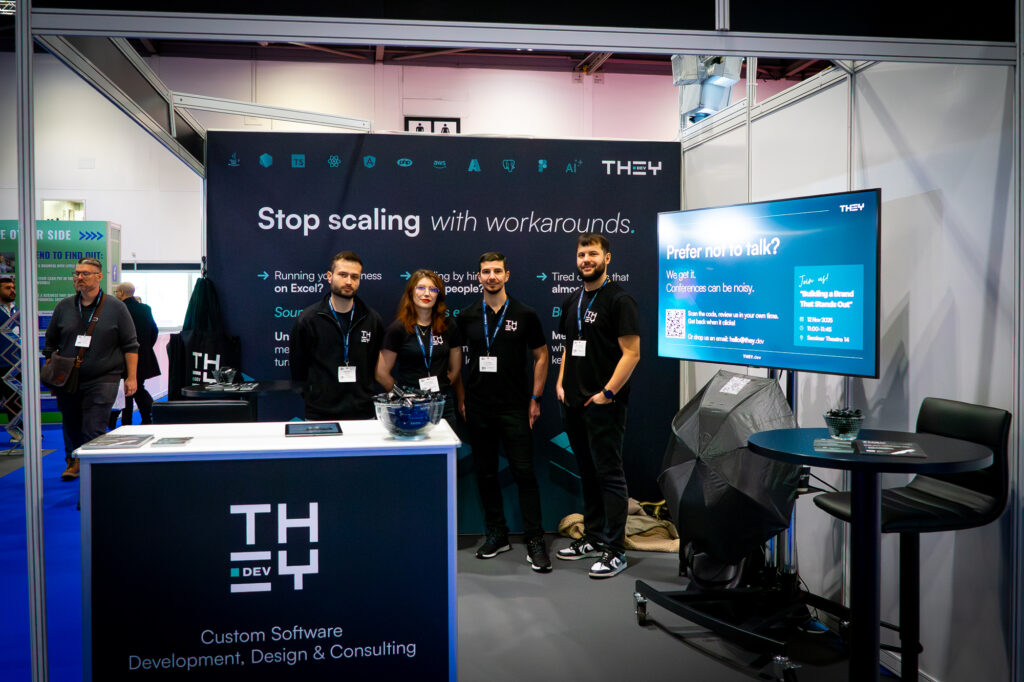
Our booth was 3 by 3 meters, so here is what we finally ordered.
I’ll also add my comment to the amounts, because this is also a question no one was able to answer – ‘how many items should we order?‘
- 1 full wall print – (2 walls would be best, but I saw way cooler stands as much as way emptier)
- 1 big screen TV (60-inch is enough, I saw around 40-inch in some stands – in my opinion, these were too small)
- 1 branded front desk (I’d consider not ordering it, to make space more open, but a lot depends on your particular booth location)
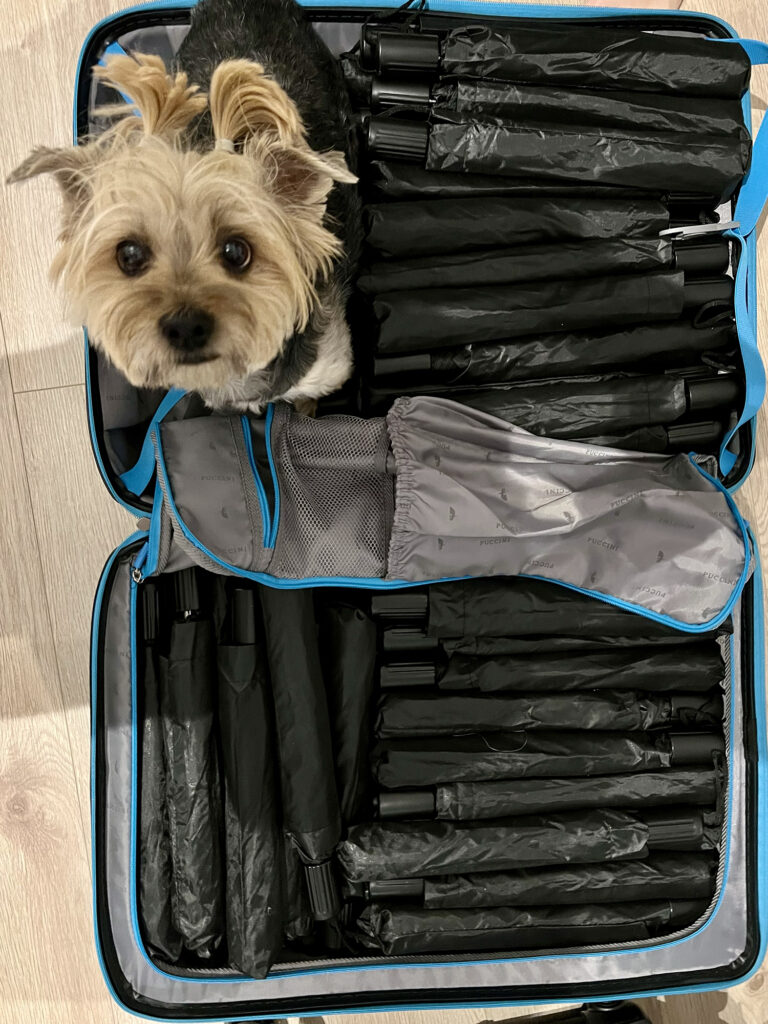
- 100 branded umbrellas (could have been more)
- 250 branded bags (spot on)
- 2 high tables (spot on)
- 2 high chairs (could be 4, but we didn’t sit that much)
- 500 leaflets (spot on)
- 450 business cards (a little too low – I’d go for at least 600 next time)
- 10 kg of Polish fudge (1kg left for the rest of the team 🙃 – spot on)
- Branded clothes (we get 2 t-shirts and 2 sweatshirts for each team member. For me, t-shirts were enough, for some 1 sweatshirt, so it’s totally up to the people you bring)
Pro tips
- Many companies are offering full-service (delivery to your booth and back) at half the price charged by the official provider.
- It’s the same price to rent it for 2 days as buying it in IKEA – if we had a physical office in London, we’d buy it.
- For the wall print, we went with an official provider, to have it done when we arrive, but last minute we started to get offers from other companies – it might also be a way to save some money.
Upsells / Extra costs we didn’t expect
- Wifi – We bought it for 1 device, because the organiser warned us not to rely on mobile or open wifi in the venue. Turned out these options were totally fine, unless you heavily rely on the internet
- Electricity – you pay for each socket in your booth. Again, we took 1 socket to plug in the TV, which was enough for this and the laptop.
- Visitor barcode scanner – we didn’t get it. It was way overpriced in my opinion, especially when you can exchange business cards or use LinkedIn.
- Stuff we didn’t get: all different furniture options, decorations, hangers, shelves, carpet, lighting and so on and so on – all at prices, where it’s cheaper to buy it in IKEA.
Mistakes
- There was no direct message about what we do in our stand. We focused on the values, hooks, and attention-grabbing, but many people came to us asking, ‘What do you actually do?’
- Some differentiation from other stands. During and after the show, we found out a couple of ways to stand out from the crowd. But this will remain our sweet secret before the next exhibition.
- Pushing the directions map late. As the show organisers had to mix the stands (due to some health and safety regulations), some of our clients came to us saying, ‘I was looking for you for almost an hour’. We pushed the post with a plan 1 day before the show – now I assume it was late.
Team preparation
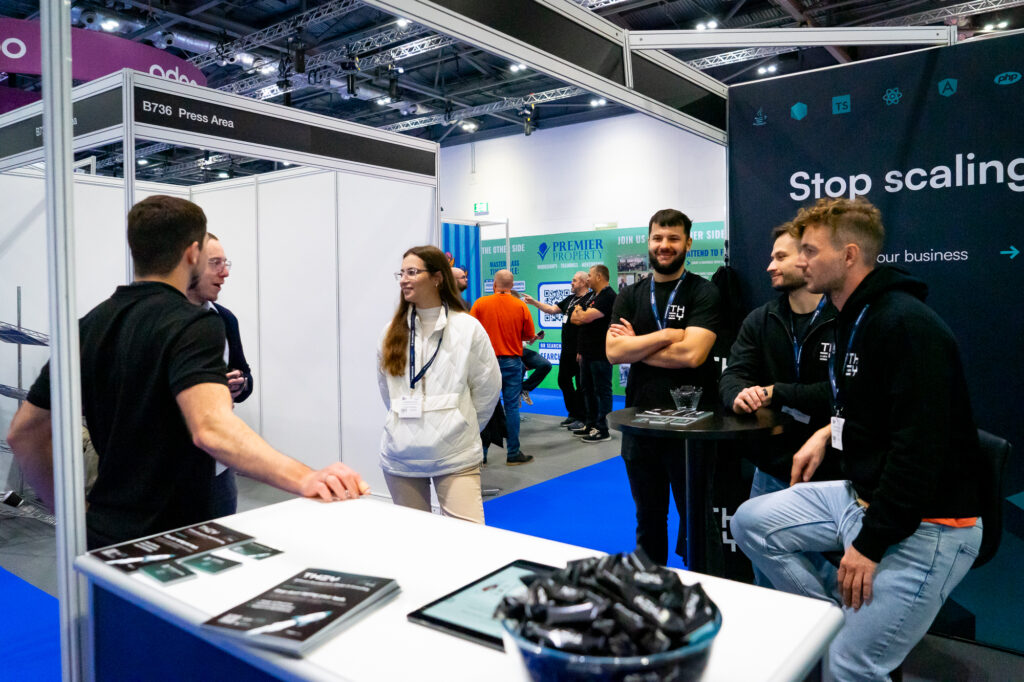
We don’t have any sales or business development team members.
So the people who were in our booth were 2 founders, 2 developers, and 1 QA. The event required some preparation, including presentations on sales, prices, services, etc. But we made it on one call, and figured out the rest during the show.
Here, I must admit I’m very proud of our people.
We’ve built a company where everyone knows almost everything about what we do, how we do it, our approach, our portfolio, and our values. Each team member describes it in their own way, but that’s where the beauty is.
We didn’t have to teach them, word by word, what to say, or ‘sell’ things in a different way.
Stand preparation
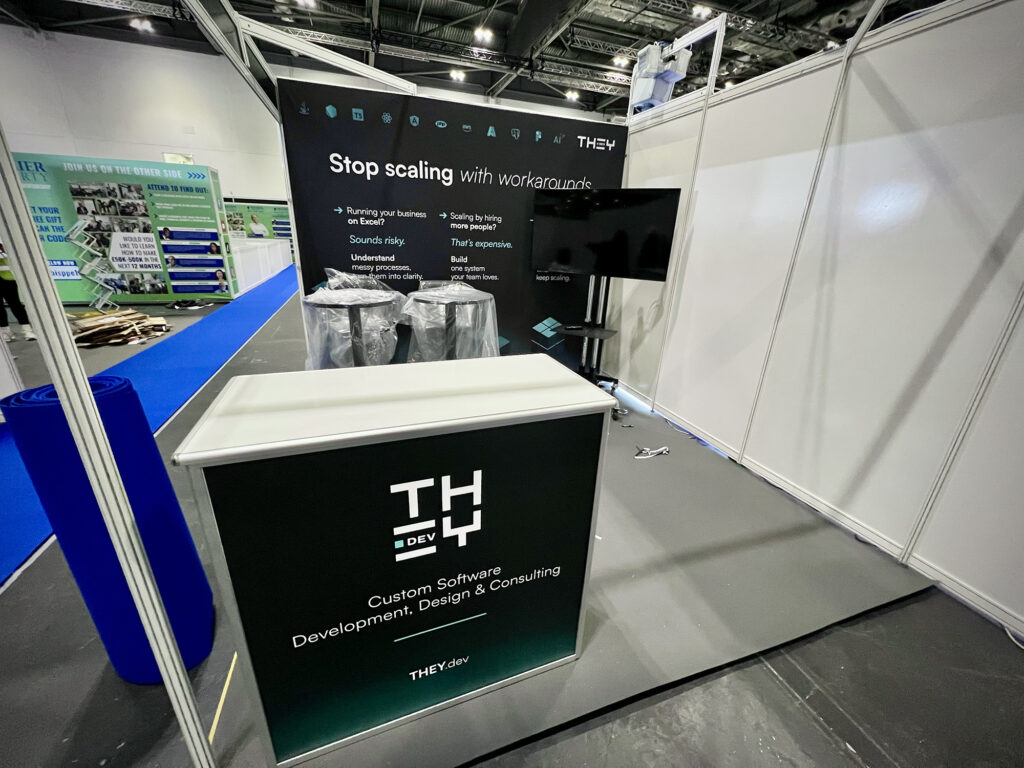
This part took us less than an hour.
When we reached the venue a day before the show, we found that things were waiting for us. The wall print was mounted. TV just required plugging in. Front desk, tables, chairs – to adjust to our vision. (Not that we’ve done this without testing 13 other variants :D)
Lastly, we brought the swag, put it around so it’s easily accessible to visitors, and we were good to go.
Pro tip: We had a pretty big front desk, so we could put the supplies and private stuff in there, although we still hid the luggage in the back of the booth. So plan where you will put more sweets, gadgets, printed materials, but also jackets, sweatshirts, etc., so they won’t end up on the floor.
At the event
Opening
A couple of minutes before the show, I recorded this video.
It was exciting to see all these people waiting to enter the event. However, it turned out that some of the early guests belonged to one of the first 3 groups described below. On the other hand, one of the first visitors we had the pleasure of speaking with had a very concrete need that we were able to address. Someone told me that only 30% of people at the show are there to buy something.
The key was to get their attention.
Visitor types
The group names should be self-explanatory. I ordered it from the largest to the smallest.
- Sweet-lifters – can’t blame them, Polish fudge is fantastic!
- Gadget-lifters – the bags hanging outside of our booth disappeared the fastest
- Students
- Very similar agency representatives
- Complementary agency representatives
- Sellers of their own products/services (often other exhibitors)
- Curious visitors – asking what we do, and genuinely interested in our services
- Potential clients – our perfect clients, unfortunately, the smallest group of them all
Don’t get me wrong – we still had a lot of meaningful conversations, but we had to learn who is who and where we should allocate our attention and time.
Conversations & Networking
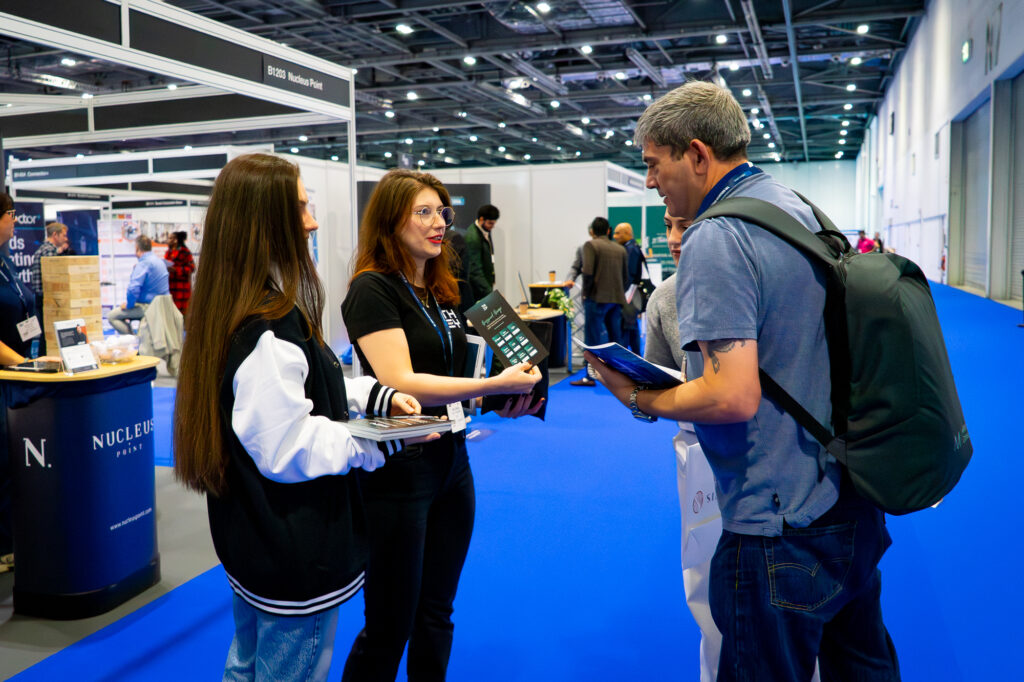
Other than waiting in the booth for people to come, we were trying to get as many conversations and as much networking as we could.
That’s why two of our team members participated in an organised Speed Networking, which was… a difficult experience. There was a limited time, so everyone just gave their pitch, exchanged business cards and switched partners. Additionally, it was in a deafening environment, so shouting was literal.
There were a few interesting contacts, but we would not repeat this.
When the show goes on, we learned to start conversations with people who were reading our wall or watching our portfolio.
This approach and stepping out of the booth were working very well. Some fascinating people got interested this way. This way, we exchanged one of the most interesting contacts.
So, in contrast to speed networking, just walking around the booth with a smile was a way more pleasant experience.
Visiting other booths
Before the show, we contacted many other exhibitors that matched our ICP.
During the show, we’ve been trying to visit as many of them as possible. Thanks to the location mix-up, it was way more difficult than we planned. But in the end, we were able to visit most of them. Some were doing things we didn’t expect from their websites, and some we didn’t plan to see turned out to be very interesting.
To sum up, this is also a good outreach technique during the live event.
Performing on stage
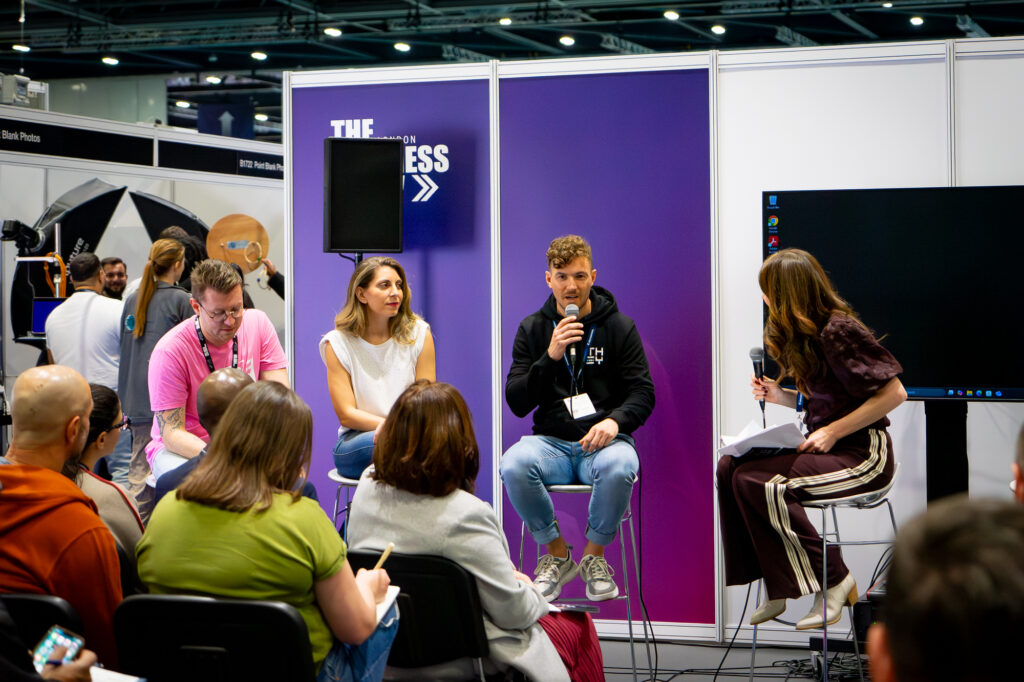
As a bonus to our TBS package, we got a slot in one of the debates during the show. (Some people were surprised that to get on stage you need to pay, it’s not the invitation only – yep, you can buy it)
Our CEO took the stage with other branding experts and engaged in a debate about standing out from the crowd. Getting more visibility this way was quite obvious, but something less obvious was the fact that other performers were fascinating people. Again, some contacts exchanged.
All in all, free was a reasonable price, but among hundreds of presentations during the show, it did not change visibility much.
Ending
On both event days after 3-4 PM, there were fewer and fewer visitors.
We’ve seen some exhibitors start packing around 3 PM on day 2. On the other hand, we had a couple of interesting meetings just before the end. At the last minute, everyone pushed away the sweets and gadgets for the visitors.
As soon as the event officially ended, we packed up and headed back to the Airbnb.
Was it worth it?
I’ll be able to respond in a couple of months.
I’m still following up with everyone and every contact I got from the show.
I can’t yet say if it will be a great source of sales now. For sure, it was different and new. I also don’t know yet if we will repeat this.
The time will show.
From these 2 event days, we gathered over 60 interesting contacts.
On top of that, we gave away hundreds of our business cards, leaflets and bags. We had tons of interesting conversations, and kilotons of visitors walking by our booth. It’s pretty hard to measure.
So we can only keep our fingers crossed.
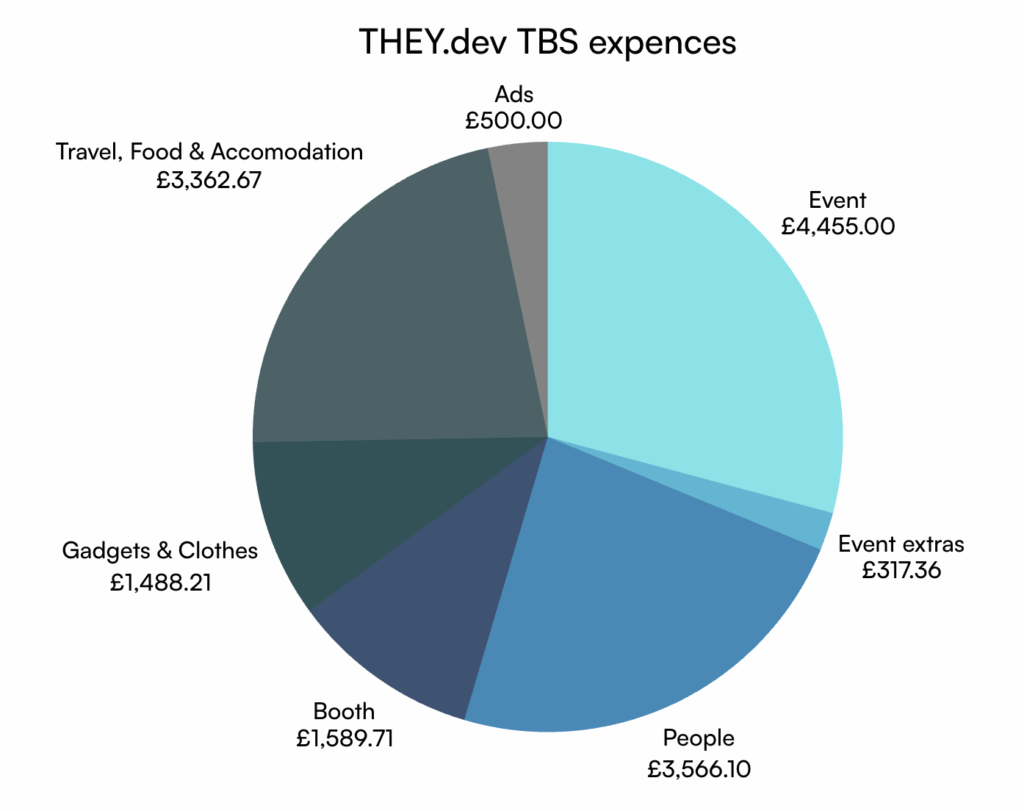
High-level expenses split
But, not to leave you without any answers – here is a detailed split of our expenses.
(Maybe) See you next year!
Of course, if you have any other questions, feel free to contact us.